The Hidden Cost of Inconsistent Pallets in Food and Cold Storage Supply Chains
A shipping line in production halts for eleven minutes due to a pallet not seating correctly on the conveyor, disrupting flow and increasing operational costs.
None of this appears as a single line item on a budget report, but it costs real money. In food and cold storage operations, it happens more often than most procurement teams track.
Pallets are treated as a commodity in many warehouses. In food manufacturing and cold storage, that assumption breaks down fast.
Why Pallet Specs Matter More in Food and Cold Storage
General warehousing has some tolerance for variation. A pallet that’s a little rough or slightly out of spec still gets product from receiving to a static rack without much drama. Food and cold storage facilities don’t get that margin.
Temperature swings between a 34-degree cooler and a loading dock at 95 degrees in July stress wood differently than a stable warehouse does. Repeated freeze-thaw cycles during blast-freezing operations crack deckboards faster, so a pallet rated for two years in ambient storage might only hold up for eight months in a minus 10 freezer rotation.
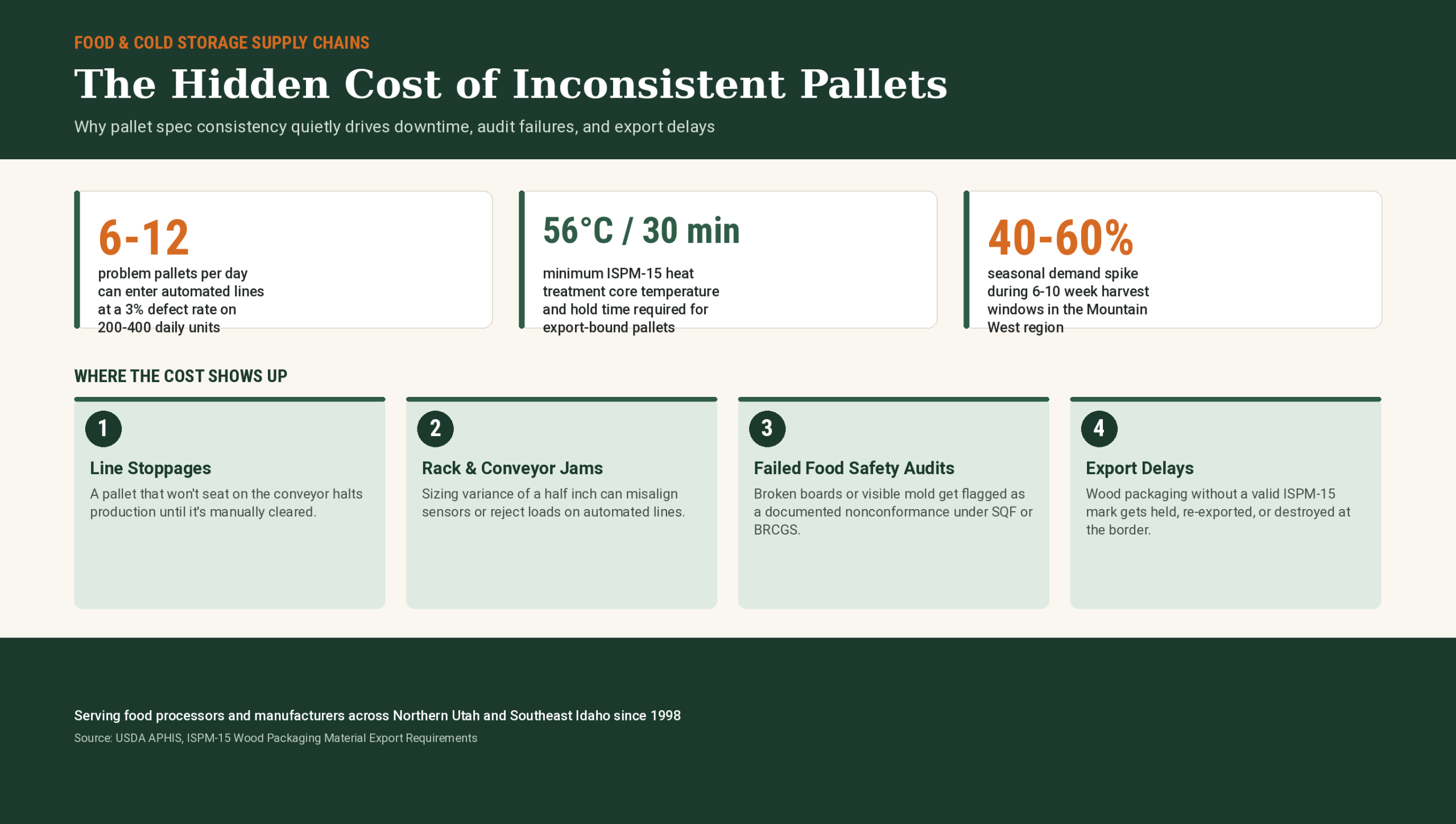
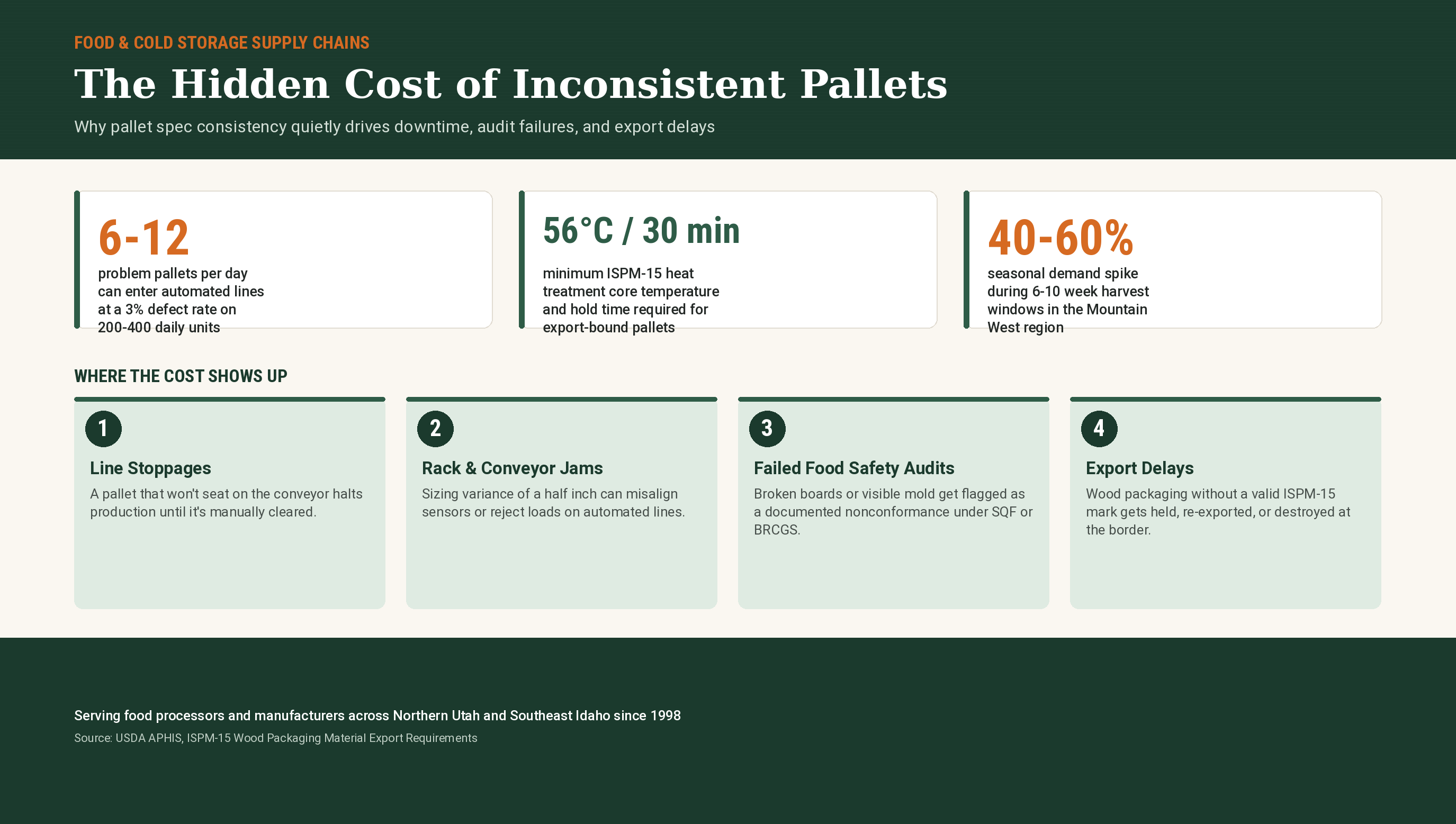
High-throughput lines compound the problem. A single food processing line can cycle 200 to 400 pallets a day at peak production. If even 3 percent have a warped stringer or loose deckboard, that’s 6 to 12 problem pallets a day feeding into automated equipment built for tight tolerances, not “close enough.”
Food safety audits raise the stakes further. Auditors under SQF, BRCGS, or a retailer’s own supplier program flag broken boards, protruding nails, and visible mold as a documented nonconformance. A failed pallet inspection not only costs the pallet but also raises safety concerns, potentially leading to safety incidents and regulatory issues, emphasizing the importance of reliable pallets.
The Real Cost of Inconsistent Sizing on Racking and Conveyors
Automated racking and conveyor systems are built around a fixed footprint. Most U.S. food and beverage operations standardize on the 48-by-40-inch GMA pallet, but “standardized” on paper and consistent in practice differ when pallets come from multiple suppliers or a mixed new-and-recycled stream.
A pallet that is half an inch wider or an inch shorter can jam a flow rack, misalign sensors, or cause load rejections, leading to hours of lost throughput each week.
Weight distribution matters just as much. Automated storage and retrieval systems (AS/RS) and narrow-aisle high-reach forklifts are calibrated for a known deck strength and load center. A pallet built with thinner boards or fewer stringers than the last batch can flex or fail under a load it was never tested against, and in a high rack that’s a safety incident, not a maintenance ticket.
Seasonal Demand Swings and Why Flexible Sourcing Matters
Food and agriculture supply chains don’t run at a flat pace year-round. Harvest season in the Mountain West can push pallet demand up 40 to 60 percent over baseline for a 6- to 10-week window as plants move potatoes, grain, or produce at peak volume. Contract manufacturing peaks tied to holiday retail cycles create a second spike in Q3 and early Q4.
A single-source supplier running at capacity during those windows leaves a plant with two bad options: slow production to match pallet availability, or accept an inconsistent mix of pallet types to keep the line moving.
Facilities that build a secondary or regional supplier into their sourcing plan, rather than scrambling when the primary source hits a wall, tend to avoid both outcomes. It only works if the backup supplier can deliver food-grade, spec-consistent pallets on short notice, instilling confidence that proactive sourcing prevents costly disruptions.
ISPM-15 and Why It Matters for Any Cross-Border Shipment
Any wood pallet crossing a U.S. border, whether headed to Canada, Mexico, or an overseas port, must meet ISPM-15, the international standard for treating wood packaging material to prevent the spread of pests such as wood-boring insects. Pallets must be debarked, heat treated to a minimum core temperature of 56 degrees Celsius for at least 30 continuous minutes, and stamped with a compliance mark before they can legally move in international trade, according to the USDA Animal and Plant Health Inspection Service.
This isn’t a paperwork formality. Noncompliant wood packaging material is rejected at the border, and the shipment can be held, re-sent, or destroyed at the exporter’s expense, resulting in days of delay and a spoiled load if the product is temperature-sensitive.
The compliance mark has specific formatting requirements, including a hyphen separating the country code from the facility code, and enforcement has tightened in recent years. A plant that assumes a supplier already handles this, without directly confirming certification, is exposed the first time a load is inspected.
A Regional Example: Southeast Idaho Food Processors
Southeast Idaho is a useful case study because it sits at the intersection of all the problems above. The Pocatello, Idaho Falls, and Rexburg corridor relies on potato processing, dairy, and other agricultural output, which means seasonal volume swings, cold storage dependence, and products that regularly cross into export channels.
Manufacturers there need pallets that hold up during freezer rotation, meet food-grade sanitation standards, and can be heat-treated to ISPM-15 spec without adding weeks to the timeline. A food-grade pallet supplier serving Southeast Idaho manufacturers has to solve for consistent sizing across new and recycled stock, seasonal capacity during harvest-driven demand spikes, and treated wood ready to move across state and international lines without a compliance scramble. It’s a narrow set of requirements, and exactly the kind of problem that gets expensive when ignored rather than planned for.
The Bottom Line
None of this shows up as a dramatic failure most weeks. It shows up as a jammed conveyor here, a failed audit note there, a rejected export pallet once a quarter. Over a year, inconsistent pallet quality is one of the more preventable, least-tracked cost centers in a food or cold storage supply chain.
About the author: This article was contributed by Delon Mortimer, head of operations and customer relations at Mortimer Pallet, a pallet manufacturer that has supplied food processors, manufacturers, and distribution operations across Northern Utah and Southeast Idaho for more than 30 years. The company builds Grade A, used, heat-treated, and custom pallets for operations that can’t afford to guess on spec.