The Geometry of Strength and Grace
Behind every elegant dovetail joint and every sweeping cabriole leg lies the first secret of woodworking: geometry is the invisible architecture of strength. The untrained eye sees a wooden chair and thinks of the wood itself. The woodworker sees load paths, triangles, and stress distributions. The secret of a mortise-and-tenon joint is not the glue—it is the long-grain-to-long-grain contact area and the mechanical lock of a well-fitted shoulder. Similarly, a simple cross-lap joint gains its rigidity from the interlocking of opposing fibers. Mastering this geometric language allows you to build pieces that last centuries. A table with properly oriented breadboard ends, allowing the central panel to expand and contract, will remain flat while a poorly designed glued slab will crack within a single season of humidity change. Geometry, not brute force, is what makes woodworking durable.
The second secret lies in the counterintuitive relationship between precision and forgiveness. Beginners often believe that perfection means zero gaps and machined exactness. But wood moves, and the master knows where to demand absolute precision and where to build in graceful allowance. For instance, drawer sides are cut slightly undersized to accommodate seasonal swelling. A panel is floated in a frame, never glued rigidly in place. The secret is that true craftsmanship is knowing exactly how much “slop” to design into a joint. A dovetail that is too tight will split the pin board when driven home; a tenon that is too loose will wobble. The sweet spot is a friction fit that requires hand pressure but not a hammer. This is the geometry of grace: understanding that wood is a living archive of its environment and designing joints that honor that life rather than fighting it.
Finally, woodworking’s most accessible secret is that you do not need a million-dollar shop to create meaningful work. The core geometry of woodworking—flat, square, and true—can be achieved with three hand tools: a sharp plane, a reliable square, and a good saw. The secret of the apprentice is to master these fundamentals on cheap construction lumber before touching exotic hardwoods. Learning to flatten one face of a twisted pine board teaches you more about wood’s behavior than any expensive machine. The honest truth is that a simple, perfectly square box made from pine, with tight miters and a sanded finish, carries more craftsmanship than a sloppy dovetail in walnut. Woodworking’s final secret, therefore, is democratic: it rewards attention, not expense. By respecting the geometry of the material and the logic of the joint, anyone with patience and a few sharp tools can transform a rough tree into a lasting testament to human care.
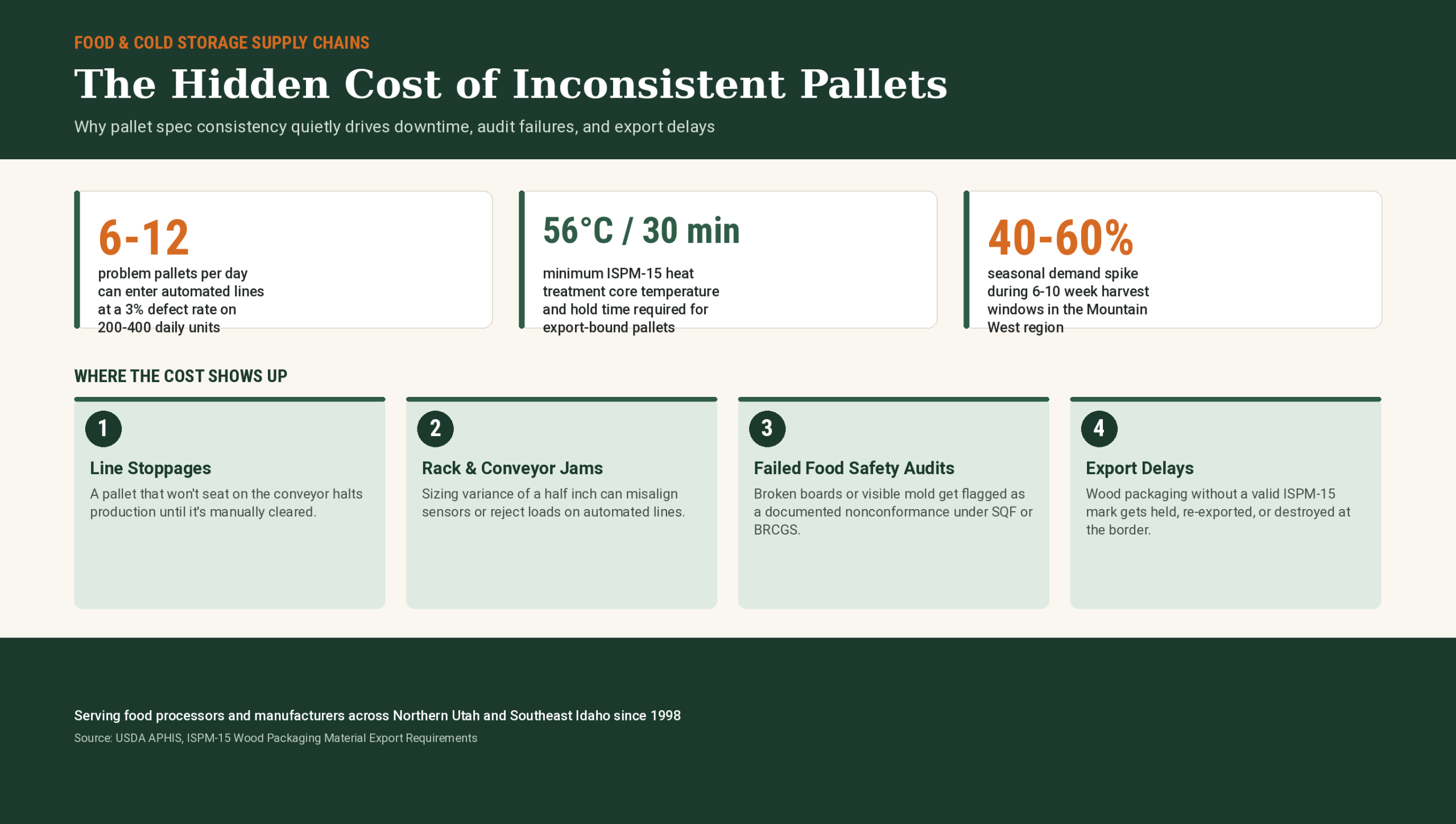
The Hidden Cost of Inconsistent Pallets in Food and Cold Storage Supply Chains
A shipping line in production halts for eleven minutes due to a pallet not seating correctly on the conveyor, disrupting flow and increasing operational costs.
None of this appears as a single line item on a budget report, but it costs real money. In food and cold storage operations, it happens more often than most procurement teams track.
Pallets are treated as a commodity in many warehouses. In food manufacturing and cold storage, that assumption breaks down fast.
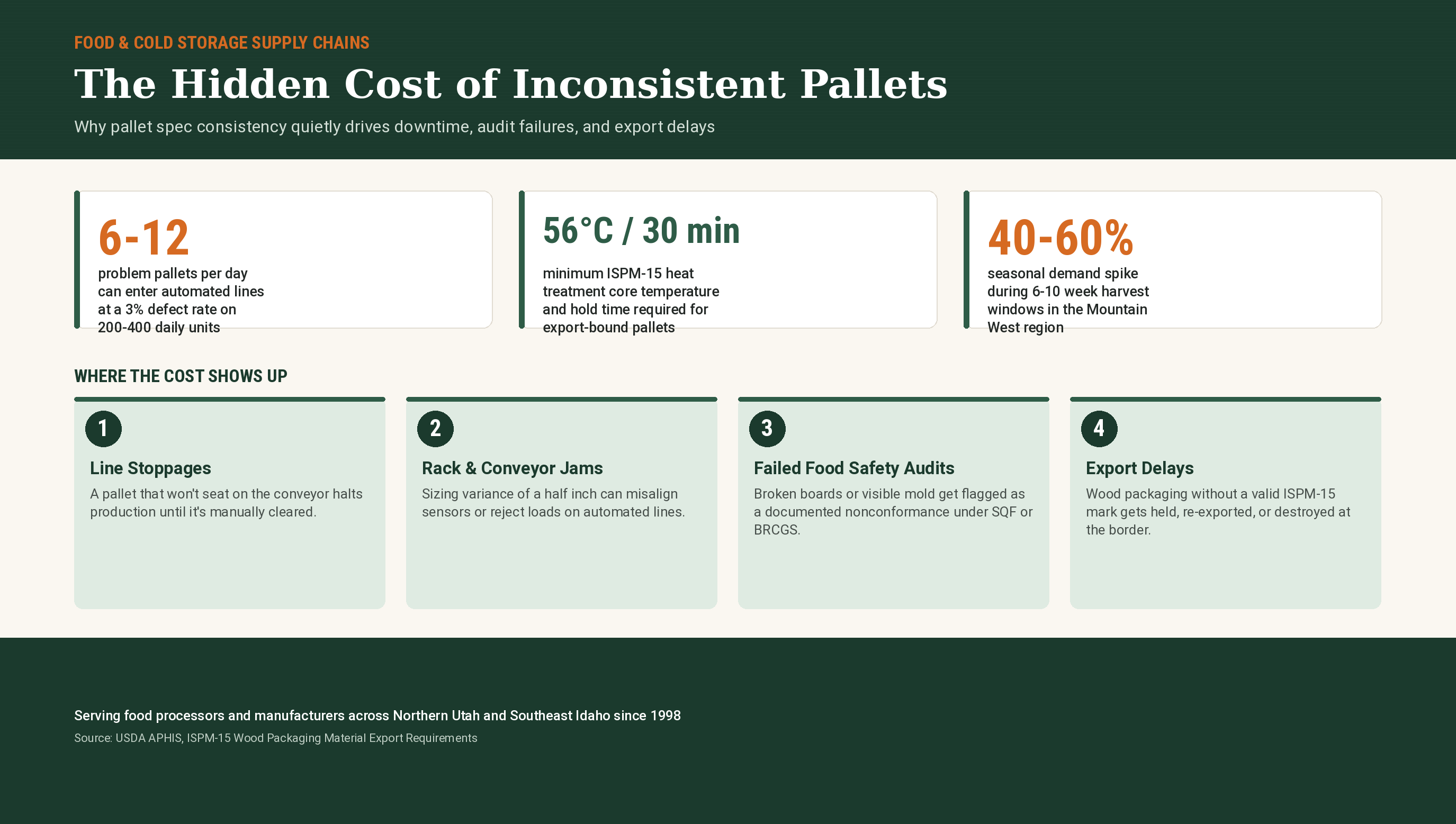
Why Pallet Specs Matter More in Food and Cold Storage
General warehousing has some tolerance for variation. A pallet that’s a little rough or slightly out of spec still gets product from receiving to a static rack without much drama. Food and cold storage facilities don’t get that margin.
Temperature swings between a 34-degree cooler and a loading dock at 95 degrees in July stress wood differently than a stable warehouse does. Repeated freeze-thaw cycles during blast-freezing operations crack deckboards faster, so a pallet rated for two years in ambient storage might only hold up for eight months in a minus 10 freezer rotation.
High-throughput lines compound the problem. A single food processing line can cycle 200 to 400 pallets a day at peak production. If even 3 percent have a warped stringer or loose deckboard, that’s 6 to 12 problem pallets a day feeding into automated equipment built for tight tolerances, not “close enough.”
Food safety audits raise the stakes further. Auditors under SQF, BRCGS, or a retailer’s own supplier program flag broken boards, protruding nails, and visible mold as a documented nonconformance. A failed pallet inspection not only costs the pallet but also raises safety concerns, potentially leading to safety incidents and regulatory issues, emphasizing the importance of reliable pallets.
The Real Cost of Inconsistent Sizing on Racking and Conveyors
Automated racking and conveyor systems are built around a fixed footprint. Most U.S. food and beverage operations standardize on the 48-by-40-inch GMA pallet, but “standardized” on paper and consistent in practice differ when pallets come from multiple suppliers or a mixed new-and-recycled stream.
A pallet that is half an inch wider or an inch shorter can jam a flow rack, misalign sensors, or cause load rejections, leading to hours of lost throughput each week.
Weight distribution matters just as much. Automated storage and retrieval systems (AS/RS) and narrow-aisle high-reach forklifts are calibrated for a known deck strength and load center. A pallet built with thinner boards or fewer stringers than the last batch can flex or fail under a load it was never tested against, and in a high rack that’s a safety incident, not a maintenance ticket.
Seasonal Demand Swings and Why Flexible Sourcing Matters
Food and agriculture supply chains don’t run at a flat pace year-round. Harvest season in the Mountain West can push pallet demand up 40 to 60 percent over baseline for a 6- to 10-week window as plants move potatoes, grain, or produce at peak volume. Contract manufacturing peaks tied to holiday retail cycles create a second spike in Q3 and early Q4.
A single-source supplier running at capacity during those windows leaves a plant with two bad options: slow production to match pallet availability, or accept an inconsistent mix of pallet types to keep the line moving.
Facilities that build a secondary or regional supplier into their sourcing plan, rather than scrambling when the primary source hits a wall, tend to avoid both outcomes. It only works if the backup supplier can deliver food-grade, spec-consistent pallets on short notice, instilling confidence that proactive sourcing prevents costly disruptions.
ISPM-15 and Why It Matters for Any Cross-Border Shipment
Any wood pallet crossing a U.S. border, whether headed to Canada, Mexico, or an overseas port, must meet ISPM-15, the international standard for treating wood packaging material to prevent the spread of pests such as wood-boring insects. Pallets must be debarked, heat treated to a minimum core temperature of 56 degrees Celsius for at least 30 continuous minutes, and stamped with a compliance mark before they can legally move in international trade, according to the USDA Animal and Plant Health Inspection Service.
This isn’t a paperwork formality. Noncompliant wood packaging material is rejected at the border, and the shipment can be held, re-sent, or destroyed at the exporter’s expense, resulting in days of delay and a spoiled load if the product is temperature-sensitive.
The compliance mark has specific formatting requirements, including a hyphen separating the country code from the facility code, and enforcement has tightened in recent years. A plant that assumes a supplier already handles this, without directly confirming certification, is exposed the first time a load is inspected.
A Regional Example: Southeast Idaho Food Processors
Southeast Idaho is a useful case study because it sits at the intersection of all the problems above. The Pocatello, Idaho Falls, and Rexburg corridor relies on potato processing, dairy, and other agricultural output, which means seasonal volume swings, cold storage dependence, and products that regularly cross into export channels.
Manufacturers there need pallets that hold up during freezer rotation, meet food-grade sanitation standards, and can be heat-treated to ISPM-15 spec without adding weeks to the timeline. A food-grade pallet supplier serving Southeast Idaho manufacturers has to solve for consistent sizing across new and recycled stock, seasonal capacity during harvest-driven demand spikes, and treated wood ready to move across state and international lines without a compliance scramble. It’s a narrow set of requirements, and exactly the kind of problem that gets expensive when ignored rather than planned for.
The Bottom Line
None of this shows up as a dramatic failure most weeks. It shows up as a jammed conveyor here, a failed audit note there, a rejected export pallet once a quarter. Over a year, inconsistent pallet quality is one of the more preventable, least-tracked cost centers in a food or cold storage supply chain.
About the author: This article was contributed by Delon Mortimer, head of operations and customer relations at Mortimer Pallet, a pallet manufacturer that has supplied food processors, manufacturers, and distribution operations across Northern Utah and Southeast Idaho for more than 30 years. The company builds Grade A, used, heat-treated, and custom pallets for operations that can’t afford to guess on spec.
top woodworking tips to get started today
The Quiet Dialogue Between Hand and Grain
Woodworking, at its core, is not merely a craft but a profound exercise in patience and listening. The first secret that every beginner must learn is that wood is never truly silent or still. It expands with humidity, contracts in dryness, warps under stress, and cracks when rushed. The master woodworker does not impose their will upon the material; instead, they enter into a quiet dialogue with it. The act of running a plane over a rough board is a conversation—you feel the changing resistance of the grain, hear the whisper of the shaving curling through the throat, and see the emerging figure of the wood itself. This sensory feedback loop is the real skill. Unlike digital work, where “undo” is a button, woodworking demands that you read the tree’s history in its rings and adjust your technique in real time.
The second hidden layer of woodworking is the discipline of subtraction. In a world obsessed with adding features, speed, and complexity, woodworking is the art of removing everything that is not the final object. This principle applies equally to sharpening a chisel, where you remove microscopic burrs to reveal a mirror edge, and to carving a leg, where you pare away waste to liberate the form inside. The secret here is that patience is a physical tool. You learn that a single, perfectly sharpened plane taking a thousandth-of-an-inch shaving will produce a surface that no sander can replicate. Rushing to remove material often creates tear-out, splits, or misalignments that take ten times longer to repair. Thus, woodworking teaches a counterintuitive truth: the slowest path—careful layout, meticulous sharpening, gentle passes—is almost always the fastest route to a heirloom-quality result.
Finally, woodworking offers a psychological sanctuary that few modern activities can match. The secret of the workshop is that it demands complete, immersive presence. When your fingers guide a spinning router bit or your mallet taps a chisel, there is no room for email notifications, social media, or abstract worries. Your mind enters a state of flow, where time distorts and the only reality is the joint you are fitting or the surface you are smoothing. This meditative quality is not a side effect; it is the primary reward. The finished table or box is simply a certificate of the journey. Woodworking’s deepest secret is that it does not just produce furniture—it produces calm, resilience, and a tangible connection to a natural material. In a fragmented, virtual world, the workshop becomes a place of wholeness, where a human, a handful of tools, and a piece of a tree create something real, lasting, and beautiful.