The Geometry of Strength and Grace
Behind every elegant dovetail joint and every sweeping cabriole leg lies the first secret of woodworking: geometry is the invisible architecture of strength. The untrained eye sees a wooden chair and thinks of the wood itself. The woodworker sees load paths, triangles, and stress distributions. The secret of a mortise-and-tenon joint is not the glue—it is the long-grain-to-long-grain contact area and the mechanical lock of a well-fitted shoulder. Similarly, a simple cross-lap joint gains its rigidity from the interlocking of opposing fibers. Mastering this geometric language allows you to build pieces that last centuries. A table with properly oriented breadboard ends, allowing the central panel to expand and contract, will remain flat while a poorly designed glued slab will crack within a single season of humidity change. Geometry, not brute force, is what makes woodworking durable.
The second secret lies in the counterintuitive relationship between precision and forgiveness. Beginners often believe that perfection means zero gaps and machined exactness. But wood moves, and the master knows where to demand absolute precision and where to build in graceful allowance. For instance, drawer sides are cut slightly undersized to accommodate seasonal swelling. A panel is floated in a frame, never glued rigidly in place. The secret is that true craftsmanship is knowing exactly how much “slop” to design into a joint. A dovetail that is too tight will split the pin board when driven home; a tenon that is too loose will wobble. The sweet spot is a friction fit that requires hand pressure but not a hammer. This is the geometry of grace: understanding that wood is a living archive of its environment and designing joints that honor that life rather than fighting it.
Finally, woodworking’s most accessible secret is that you do not need a million-dollar shop to create meaningful work. The core geometry of woodworking—flat, square, and true—can be achieved with three hand tools: a sharp plane, a reliable square, and a good saw. The secret of the apprentice is to master these fundamentals on cheap construction lumber before touching exotic hardwoods. Learning to flatten one face of a twisted pine board teaches you more about wood’s behavior than any expensive machine. The honest truth is that a simple, perfectly square box made from pine, with tight miters and a sanded finish, carries more craftsmanship than a sloppy dovetail in walnut. Woodworking’s final secret, therefore, is democratic: it rewards attention, not expense. By respecting the geometry of the material and the logic of the joint, anyone with patience and a few sharp tools can transform a rough tree into a lasting testament to human care.
The Hidden Cost of Inconsistent Pallets in Food and Cold Storage Supply Chains
A shipping line in production halts for eleven minutes due to a pallet not seating correctly on the conveyor, disrupting flow and increasing operational costs.
None of this appears as a single line item on a budget report, but it costs real money. In food and cold storage operations, it happens more often than most procurement teams track.
Pallets are treated as a commodity in many warehouses. In food manufacturing and cold storage, that assumption breaks down fast.
Why Pallet Specs Matter More in Food and Cold Storage
General warehousing has some tolerance for variation. A pallet that’s a little rough or slightly out of spec still gets product from receiving to a static rack without much drama. Food and cold storage facilities don’t get that margin.
Temperature swings between a 34-degree cooler and a loading dock at 95 degrees in July stress wood differently than a stable warehouse does. Repeated freeze-thaw cycles during blast-freezing operations crack deckboards faster, so a pallet rated for two years in ambient storage might only hold up for eight months in a minus 10 freezer rotation.
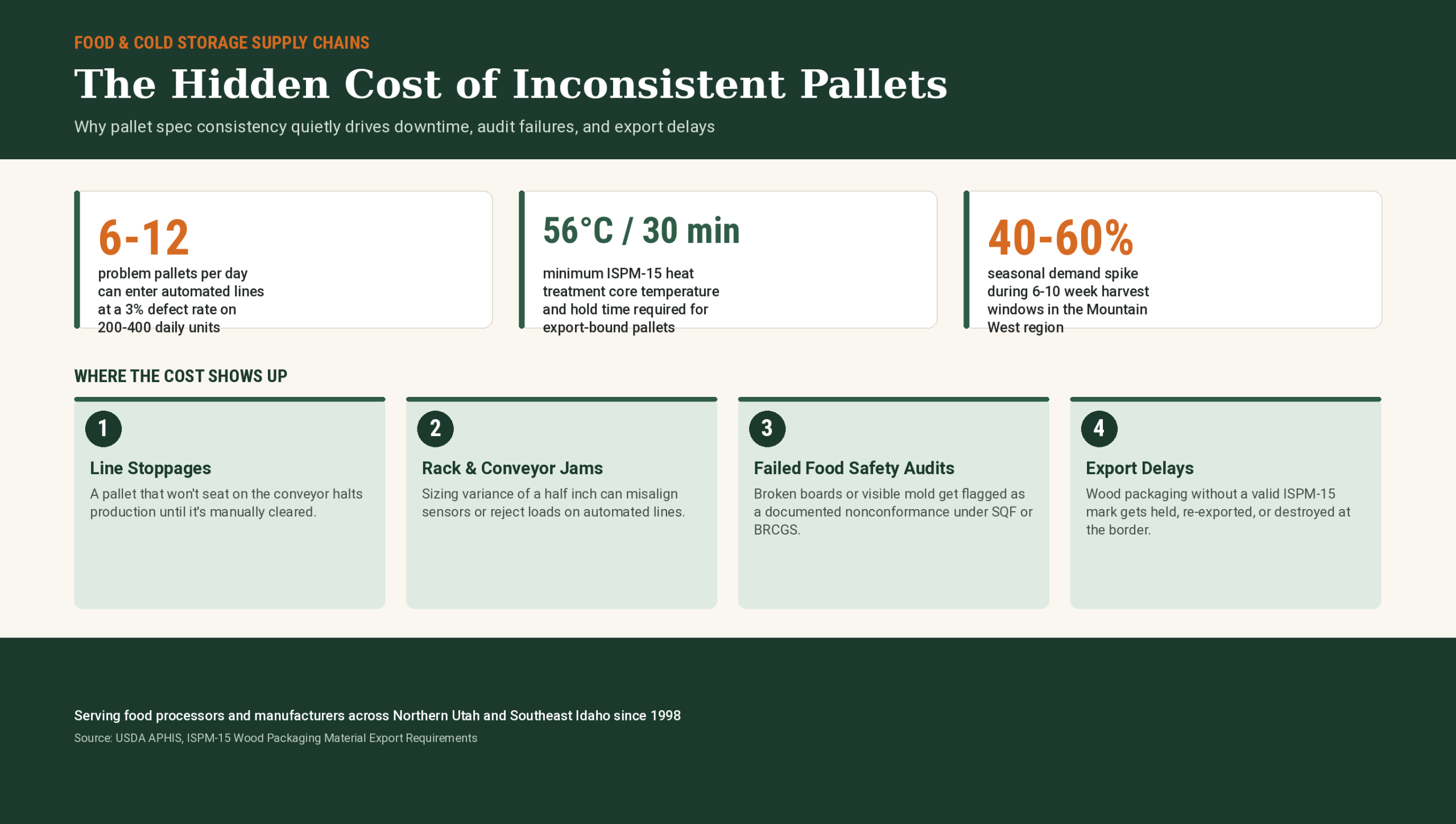
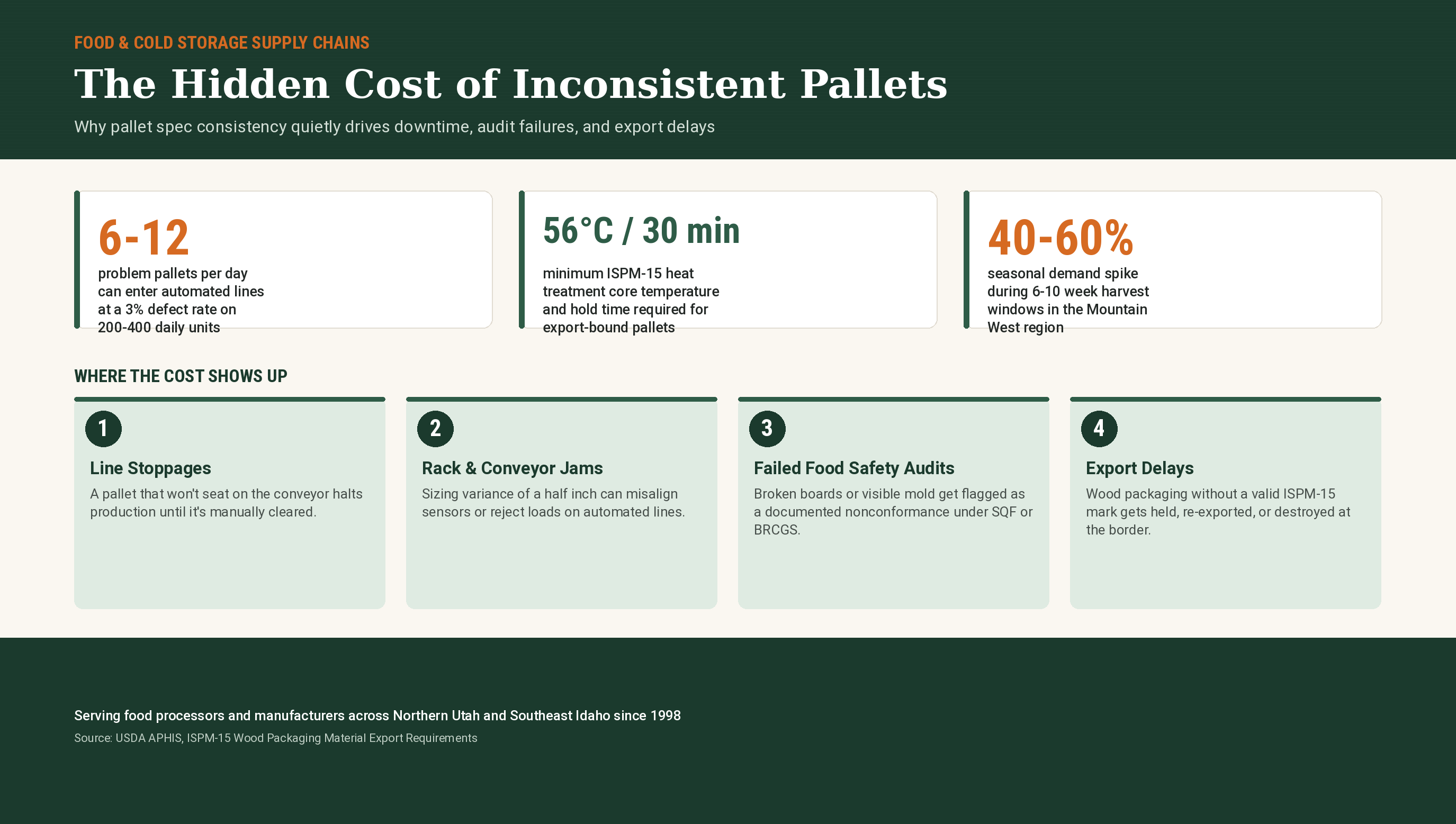
High-throughput lines compound the problem. A single food processing line can cycle 200 to 400 pallets a day at peak production. If even 3 percent have a warped stringer or loose deckboard, that’s 6 to 12 problem pallets a day feeding into automated equipment built for tight tolerances, not “close enough.”
Food safety audits raise the stakes further. Auditors under SQF, BRCGS, or a retailer’s own supplier program flag broken boards, protruding nails, and visible mold as a documented nonconformance. A failed pallet inspection not only costs the pallet but also raises safety concerns, potentially leading to safety incidents and regulatory issues, emphasizing the importance of reliable pallets.
The Real Cost of Inconsistent Sizing on Racking and Conveyors
Automated racking and conveyor systems are built around a fixed footprint. Most U.S. food and beverage operations standardize on the 48-by-40-inch GMA pallet, but “standardized” on paper and consistent in practice differ when pallets come from multiple suppliers or a mixed new-and-recycled stream.
A pallet that is half an inch wider or an inch shorter can jam a flow rack, misalign sensors, or cause load rejections, leading to hours of lost throughput each week.
Weight distribution matters just as much. Automated storage and retrieval systems (AS/RS) and narrow-aisle high-reach forklifts are calibrated for a known deck strength and load center. A pallet built with thinner boards or fewer stringers than the last batch can flex or fail under a load it was never tested against, and in a high rack that’s a safety incident, not a maintenance ticket.
Seasonal Demand Swings and Why Flexible Sourcing Matters
Food and agriculture supply chains don’t run at a flat pace year-round. Harvest season in the Mountain West can push pallet demand up 40 to 60 percent over baseline for a 6- to 10-week window as plants move potatoes, grain, or produce at peak volume. Contract manufacturing peaks tied to holiday retail cycles create a second spike in Q3 and early Q4.
A single-source supplier running at capacity during those windows leaves a plant with two bad options: slow production to match pallet availability, or accept an inconsistent mix of pallet types to keep the line moving.
Facilities that build a secondary or regional supplier into their sourcing plan, rather than scrambling when the primary source hits a wall, tend to avoid both outcomes. It only works if the backup supplier can deliver food-grade, spec-consistent pallets on short notice, instilling confidence that proactive sourcing prevents costly disruptions.
ISPM-15 and Why It Matters for Any Cross-Border Shipment
Any wood pallet crossing a U.S. border, whether headed to Canada, Mexico, or an overseas port, must meet ISPM-15, the international standard for treating wood packaging material to prevent the spread of pests such as wood-boring insects. Pallets must be debarked, heat treated to a minimum core temperature of 56 degrees Celsius for at least 30 continuous minutes, and stamped with a compliance mark before they can legally move in international trade, according to the USDA Animal and Plant Health Inspection Service.
This isn’t a paperwork formality. Noncompliant wood packaging material is rejected at the border, and the shipment can be held, re-sent, or destroyed at the exporter’s expense, resulting in days of delay and a spoiled load if the product is temperature-sensitive.
The compliance mark has specific formatting requirements, including a hyphen separating the country code from the facility code, and enforcement has tightened in recent years. A plant that assumes a supplier already handles this, without directly confirming certification, is exposed the first time a load is inspected.
A Regional Example: Southeast Idaho Food Processors
Southeast Idaho is a useful case study because it sits at the intersection of all the problems above. The Pocatello, Idaho Falls, and Rexburg corridor relies on potato processing, dairy, and other agricultural output, which means seasonal volume swings, cold storage dependence, and products that regularly cross into export channels.
Manufacturers there need pallets that hold up during freezer rotation, meet food-grade sanitation standards, and can be heat-treated to ISPM-15 spec without adding weeks to the timeline. A food-grade pallet supplier serving Southeast Idaho manufacturers has to solve for consistent sizing across new and recycled stock, seasonal capacity during harvest-driven demand spikes, and treated wood ready to move across state and international lines without a compliance scramble. It’s a narrow set of requirements, and exactly the kind of problem that gets expensive when ignored rather than planned for.
The Bottom Line
None of this shows up as a dramatic failure most weeks. It shows up as a jammed conveyor here, a failed audit note there, a rejected export pallet once a quarter. Over a year, inconsistent pallet quality is one of the more preventable, least-tracked cost centers in a food or cold storage supply chain.
About the author: This article was contributed by Delon Mortimer, head of operations and customer relations at Mortimer Pallet, a pallet manufacturer that has supplied food processors, manufacturers, and distribution operations across Northern Utah and Southeast Idaho for more than 30 years. The company builds Grade A, used, heat-treated, and custom pallets for operations that can’t afford to guess on spec.
Risk Management for Active CFD Traders: Beyond Stop Losses and Take Profits
CFD trading attracts active traders because of its flexibility, high leverage, and access to a wide range of global markets. But these advantages also bring significant risks. It’s easy to get caught up in the fast pace of price action and overlook the importance of a comprehensive risk strategy. As market dynamics grow more complex and price movements more unpredictable, it’s time to look beyond the basics. Successful CFD trading hinges on developing a layered approach that includes volatility analysis, portfolio diversification, psychological discipline, and real-time adaptability. In this article, we explore a deeper and more effective way to manage risk when trading CFDs.
The Foundation: Traditional Risk Controls
Every discussion about managing trading risk should begin with the fundamentals. Stop-loss and take-profit orders are the standard tools that most traders use to automate exits and protect their accounts from sudden reversals. A stop-loss ensures that you cut losses early, while a take-profit allows you to lock in gains once a target is reached. These controls create discipline and help remove emotional decision-making from the exit process.
However, these tools have significant limitations. In fast-moving markets, prices can gap past your stop-loss level, resulting in greater losses than expected. Similarly, fixed take-profits may cap your upside on trades that could have run longer. If you rely entirely on these mechanisms, you risk falling into a rigid system that doesn’t respond well to live market conditions.
A more sophisticated approach starts with understanding the broader risk management definition — the identification, assessment, and mitigation of exposure to potential losses. From this foundation, traders can add adaptive tools that evolve with the market, rather than static orders that operate in isolation.
Volatility-Based Risk Management
Markets don’t move in straight lines, and volatility can vary widely from one trading session to the next. Rather than using arbitrary stop distances, many advanced traders factor in volatility indicators like the Average True Range (ATR) to determine more effective entry and exit levels. A highly volatile asset might require wider stops to avoid getting stopped out prematurely, while a stable market allows for tighter control.
By tying your stop-loss distance to the instrument’s volatility, you gain the flexibility to adapt to different trading conditions. ATR-based stop placement is especially valuable in news-driven markets or during economic data releases when price swings can be severe and unpredictable.
Volatility can also guide trailing stop strategies. Instead of using a fixed pip value, trailing stops can be adjusted in line with ATR values to maintain a consistent risk buffer, even as a position moves in your favour. This dynamic approach prevents random stop-outs and helps protect profits when trends extend.
Risk-to-Reward Optimization
One of the cornerstones of successful CFD trading is making sure each trade offers more potential upside than downside. This is where risk-to-reward ratios come in. The idea is simple: don’t take a trade unless the potential gain justifies the potential loss.
For example, if you’re risking $100, your expected profit should be at least $200, giving you a 1:2 ratio. While this sounds straightforward, many traders violate this rule under pressure, often cutting winning trades short while letting losing trades run. A disciplined commitment to favourable risk-reward setups helps counteract these emotional pitfalls.
To make this work, you also need to account for your win/loss probability. If your trading strategy produces many small winners and occasional big losers, your average risk-reward ratio may still be unfavourable, even with a high win rate. Backtesting and forward-testing your strategy help identify whether your setups truly offer a positive expectancy over time.
Time-Based Risk Controls
Not all risks are related to price. Sometimes, it’s how long a trade is open that creates exposure. Time-based risk management adds a new layer by placing limits on the duration of a trade.
For example, holding positions overnight can expose traders to unexpected gaps or spreads during low liquidity periods. Similarly, weekend positions might be affected by geopolitical developments or news that drops when markets are closed. Many active traders avoid this risk by day trading or setting a fixed maximum time limit for each trade.
Time-based exits can also help you avoid unproductive trades. If a position hasn’t moved significantly in your favour within a certain time window, it may indicate the setup is weakening. In such cases, exiting early helps free up capital for better opportunities.
Conclusion
Risk management for CFD traders must go beyond stop losses and take profits. While these tools are useful, they only form the base of a much broader and more effective risk strategy. Volatility awareness, portfolio balance, psychological discipline, and technological tools all play essential roles in building a resilient approach. The goal isn’t just to avoid losing trades—it’s to ensure that when losses occur (and they will), they don’t derail your account or your confidence. By taking a multidimensional view of risk, traders position themselves for long-term sustainability and consistent performance in the ever-evolving CFD markets.

Engagement Strategies The Future of Online Shopping
Each year, researchers anxiously review the fluctuations in retail vs. online shopping behaviours. According to previous studies, a seasonal shopping peak experienced at Christmas, see’s certain shopping behaviour trends and shifts each year. ‘Cyber Monday’ occurs in November and describes online shopping habits. In November 2011, our last Cyber Monday, it was estimated that 122.9 million people went online to purchase, according to a survey conducted by BIGresearch for , which is up from 106.9 million in 2010. As retailers compete with the online discounts available to consumers especially at this time of year, ‘Black Friday’ represents the traditional day brick and mortar retailers launch the Christmas shopping season. It’s interesting to see that Black Friday saw online sales rise 26% from that of 2010 (according to comScore), while the number of people visiting online retailing sites was up 35%. Another study conducted by a panel of retail experts brought together for a BT-led Retailtopia project have recently announced their visions for the future of UK retail and there is a prime focus on online engagement strategies.
As we continue to see an evolution of technology, we also continue to see our traditional shopping experiences growing and adapting. It is predicted that those retailers that stay on top of these emerging technologies will lead the way and benefit from staying innovative and interactive with their customer base. Predictions include services offered to include same day delivery and constant stock availability and people looking for complete savings online. Professor Patrick Barwise, chair of the Retailtopia panel and a chairman of Which?, said: “The UK is already a global leader in online shopping, with nearly 30bn of sales coming through this channel in 2011.” Some additional insights from Retailtopia’s ten predictions include: – Physical stores will still have a vital role, increasingly focused on complementing digital channels. – Retail experiences will become more customised, personal and interactive. – Wireless enabled in-store environments will help retailers connect in helpful ways with customers while shopping, releasing staff from tills and empowering customers to actively use personal mobile devices. – Fulfilment of online retail purchases will be more cost-effective and efficient thanks to automation and greater co-operation between retailers and supply chain partners. It is fair to say that whilst research will always report on trends, shifts and predictions in buying power and behaviours, people are looking online for discounts and savings. With Complete Savings, consumers will benefit from continuous online savings and rewards.
Where to Find Best And Cheapest UGG Boots
UGG Classic Tall offers total comfort, warmth and functionality, and the UGG Classic Tall 5815 version gives a cozy, comfortable feeling against bare legs. Features a molded rubber lugged outsole for traction and slip resistance. High quality, sheepskin upper with premium fleece lining absorbs moisture and keeps your feet dry and comfortable in both warm and cold climates. Black UGG 5815 runs somewhat large, about a whole size if you plan to wear them barefoot. I wear them all day, and have even worn them to work on occasion! I purchased a leather spray for this pair and it has helped to protect them a little, I would recommend not wearing them in damp conditions though.
You will not believe how warm and comfortable they are! Customer service was pretty good I would definitely recommend these to everyone. offers latest style and highest quality UGG boots at great prices to people. Our UGG Boots are not only comfortable but also extremely fashionable hot. You will be crazy about these UGGs’ style, comfort and luxury. And you’ll look trendy and stylish in sheepskin boots by these boots. No matter whether you are looking for classic 5815 boots, or 5802 tall flower blush still satisfies what you need.
What’s more, UGGs in are all available in chocolate, chestnut, sand, pink, beige and so on. All the people, women, men as well as kids, can also choose different colors to match the different moods. It’s really a great idea to choose attractive and luxury-like UGG Boots for your families and yourselves. You can find more UGG boots at: